
America 250 and the Enduring Story of West Point
As the United States approaches the 250th anniversary of the signing of the Declaration of Independence, Americans across the country reflect on the people, places, and ideas that shaped the nation’s history. The signing in 1776 launched the American experiment, but independence itself was not guaranteed with the stroke of a pen. It would be fought for across battlefields, rivers, mountains, and frontier settlements by soldiers, laborers, engineers, militia members, and citizens determined to secure the future of a new nation.At the West Point Press, we view the America 250 celebration as an opportunity to explore and articulate how West Point’s distinctive contributions have shaped the nation’s survival and ongoing story. The anniversary is not only a moment to commemorate the nation’s founding but also to highlight the enduring importance of places like West Point in the American narrative. Few places embody this story more clearly than West Point itself.Before becoming home to the United States Military Academy, West Point was a pivotal Revolutionary War stronghold. Situated above the Hudson River, it controlled one of North America’s most strategic locations. General Washington knew that holding the Hudson was vital—British control could have split the colonies and altered the war.
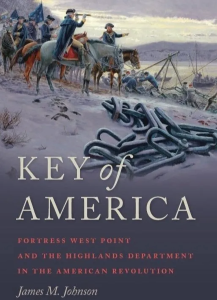 Key of America by James M. Johnson delivers an in-depth exploration of this pivotal chapter in American history. The book examines the history of the Hudson Highlands and the immense effort required to construct and maintain the fortifications that ultimately made the region too formidable for British assault. Through vivid accounts of engineering, logistics, military planning, and the harsh realities faced by soldiers and laborers, the work reveals how an emerging nation accomplished extraordinary feats with limited resources in a revolutionary environment.
The title itself comes from Washington’s own description of the Hudson Highlands as the “key of America,” a phrase that captures both the military and symbolic significance of the region. As America approaches its semi-quincentennial, that idea remains powerful. The story of the Revolution is more than declarations and famous battles; it is also one of perseverance, innovation, sacrifice, and strategic vision.
Readers interested in a broader examination of the Revolutionary War are encouraged to explore The West Point History of the American Revolution, a digital textbook published through West Point Digital Publishing. Drawing on the expertise of military historians and enhanced with interactive features such as animated campaign maps, data visualizations, primary-source materials, and detailed battle studies, the text offers a comprehensive look at the conflict from the tensions that preceded the war through the challenges of building a new nation afterward. By combining scholarship with digital tools, the volume provides additional ways for students and readers to engage more deeply with the history of the American founding.
That broader Revolutionary story is further expanded in another work by Johnson, Militiamen, Rangers, and Redcoats. Focusing on Georgia between 1754 and 1776, the book explores the military forces, frontier conflicts, and colonial dynamics that shaped the southern theater before the Revolution fully erupted. Together, these works demonstrate how regional histories across the colonies contributed to the larger struggle for independence and nationhood.
The America 250 commemoration also provides an opportunity to reflect on the generations that followed the Revolution and continued shaping the nation through leadership, service, and reform. That legacy is deeply connected to the history of West Point itself.
The physical evolution of the Academy during America’s formative years is explored in The West Point Landscape: 1802–1860 by Jon C. Malinowski. Through maps, historical illustrations, and extensive research, the book chronicles the transformation of West Point from a rugged military outpost into a growing institution of military education. By tracing changes to the landscape, infrastructure, and built environment, Malinowski offers readers a unique perspective on how the Academy developed alongside the young republic it served.
 In An Annotated Autobiography of Henry O. Flipper, readers encounter his remarkable firsthand account. His experiences as a cadet and Army officer illuminate both the opportunities and challenges present in post–Civil War America. Flipper’s story reflects themes of perseverance, excellence, and resilience that continue to resonate today and demonstrates how the history of the United States has always been shaped by individuals moving the nation toward its ideals.
Similarly, Sylvanus Thayer: A Biography highlights the legacy of Sylvanus Thayer, often called the “Father of the Military Academy.” His reforms transformed the Academy into one of the nation’s premier institutions for military and engineering education, helping prepare generations of Army officers who would go on to serve the country in times of war and peace alike. Thayer’s influence established the standards of discipline, scholarship, and leadership that continue to define West Point today.
As the nation reflects on 250 years of history, these works collectively remind readers that America’s story is larger than any single event. It is a story built over centuries by people willing to defend ideals, overcome hardship, and invest in institutions that would outlast them. From the fortifications overlooking the Hudson River during the Revolution to the classrooms and barracks of modern West Point, the threads of service and national purpose remain deeply connected.
The America 250 celebration invites Americans reflect on the nation’s founding and its enduring history. Through its history titles, West Point Press proudly contributes to that ongoing conversation by preserving and sharing scholarship that helps readers better understand the people, places, and ideas that continue to shape the United States today. In addition to West Point Press publications, West Point Digital Publishing offers a growing collection of digital textbooks covering a variety of historical topics. Designed for educational use, these texts adapt to meet the needs of individual courses and instructors while providing students new ways to engage with historical scholarship and primary-source material.